The landscape of search is changing rapidly. Users are no longer typing keywords into Google and clicking a blue link from the ten results that appear. They are now asking the entire question and expecting that AI-driven platforms will provide concise, summarized answers in return.
With Google AI Overviews, Google AI Mode, ChatGPT, Perplexity, Gemini, Claude and many other AI-powered search experiences changing how we get information, buy things, compare services and look for products, it’s clear that new avenues for digital marketing, Generative Engine Optimization (GEO), are opening up. Google’s AI Mode is described as an experience which you can use for organizing, responding to tough queries and linking back to related pages.
What is GEO, how does it differ from traditional SEO, and how should business optimize sites in 2026? Keep reading to find out.
Why Use Generative Engine Optimization (GEO)?
Generative Engine Optimization, or GEO is the process through which one aims to have their business, website, brand and presence generally be able to be searched, understood, retrieved, mentioned and cited within AI-powered generated search answers related to user inquiries. Traditional SEO has two main tasks.
In traditional SEO, the goal is generally to improve a webpage’s visibility in search engine results.
With GEO, the objective expands beyond traditional rankings. You want your brand or content to become a useful and trustworthy source that AI systems can incorporate into generated answers.
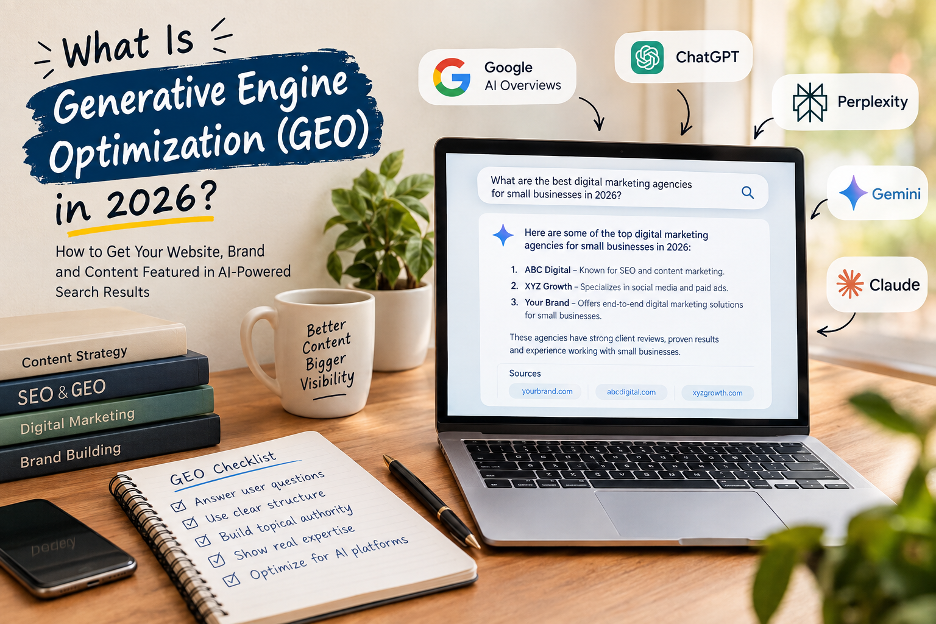
For example, a user might ask:
“What are the best digital marketing agencies for small businesses?”
Instead of receiving only a list of webpages, an AI-powered search experience may generate a summarized answer and provide supporting sources.
If your company is mentioned or cited within that answer, your website has achieved an important form of AI search visibility.
GEO therefore focuses on making information:
- Easy for AI systems to understand
- Clear and directly answerable
- Factually accurate
- Well structured
- Supported by credible sources
- Consistent across the web
- Useful for real users
- Relevant to specific search intent
The important point is that GEO does not replace SEO. Google specifically states that its generative AI search features are rooted in existing Search ranking and quality systems, meaning strong SEO remains an important foundation.
Why Is GEO Important in 2026?
The way people search is becoming more conversational.
Instead of searching:
“best SEO agency India”
a user might ask:
“Which SEO agencies in India are suitable for a small eCommerce business looking for international customers?”
AI search engines can interpret the context behind the question and synthesize information from multiple sources.
Google has continued expanding AI Overviews and AI Mode, including more conversational interactions and links to relevant web content.
This means businesses now need to think about two connected visibility layers:
Traditional Search Visibility
Your website appears in:
- Organic search results
- Featured snippets
- Local results
- Image search
- Video search
- Shopping results
Generative Search Visibility
Your brand or content may appear through:
- AI Overviews
- AI Mode
- ChatGPT
- Perplexity
- Gemini
- Claude
- Other AI-powered discovery experiences
The future of search is therefore not simply about ranking higher. It is increasingly about becoming a source that AI systems can confidently use.
GEO vs SEO: What’s the Difference?
SEO and GEO overlap significantly, but their objectives are different.
| SEO | GEO |
| ● Optimizes for search engines | ● Optimizes for generative AI experiences |
| ● Focuses heavily on rankings | ● Focuses on mentions, citations and inclusion |
| ● Targets keywords and search queries | ● Targets questions, topics and entities |
| ● Optimizes webpages | ● Optimizes content and broader brand information |
| ● Measures rankings and organic traffic | ● Measures AI visibility, citations and AI-driven traffic |
| ● Traditional search results | ● AI-generated answers and conversational search
|
However, GEO should not be treated as an entirely separate replacement for SEO.
Google’s official documentation states that SEO best practices remain relevant because generative AI features use Google’s existing Search systems and indexed content.
A strong 2026 strategy therefore combines SEO + content quality + entity optimization + AI visibility.
How Does Generative Engine Optimization Work?
AI search systems need information they can retrieve, interpret, evaluate, and use to construct an answer.
Your content therefore needs to communicate information clearly.
A simplified GEO process looks like this:
User question → AI interprets intent → Relevant sources retrieved → Information evaluated → Answer generated → Sources potentially cited
This makes content structure particularly important.
For example, instead of writing:
“Our company provides innovative solutions designed to transform businesses.”
A more useful approach is:
“We provide SEO services for eCommerce businesses, including technical SEO, keyword research, content optimization, link building, and Google Search Console analysis.”
The second version provides clearer information that both users and information-retrieval systems can understand.
10 Effective GEO Strategies for 2026
- Create Answer-Focused Content
One of the strongest GEO principles is to answer questions directly.
Create content around questions your customers actually ask.
Examples include:
- What is SEO?
- How much does SEO cost?
- How does technical SEO work?
- What is Generative Engine Optimization?
- How can businesses appear in AI search?
- What is the difference between SEO and GEO?
Give the answer early, then expand with supporting information.
This makes your content easier to scan and understand.
- Target Conversational Search Queries
Traditional keyword research often focuses on short phrases.
GEO requires looking beyond short keywords.
For example:
Traditional keyword:
“CRM software”
Conversational query:
“What is the best CRM software for a small business with a five-person sales team?”
This means your content strategy should include:
- Question keywords
- Long-tail searches
- Comparison queries
- Problem-based searches
- “How” queries
- “Why” queries
- “Best” queries
- “Vs” queries
- Purchase-intent questions
The more closely your content matches real-world questions, the more useful it can become.
- Build Topic Authority
One article is rarely enough to establish strong authority around a competitive subject.
Instead, create a topic cluster.
For example, a website targeting GEO could publish:
- What Is Generative Engine Optimization?
- GEO vs SEO
- GEO vs AEO
- How Does AI Search Work?
- How to Optimize Content for ChatGPT
- How to Optimize for Google AI Overviews
- Best GEO Tools
- How to Measure AI Search Visibility
- GEO Strategy for eCommerce
- GEO Strategy for Local Businesses
Connect these pages through internal links.
This helps create a comprehensive knowledge structure around the topic.
- Demonstrate First-Hand Expertise
AI-generated content is everywhere in 2026.
Simply producing more generic articles isn’t enough.
Your content should demonstrate:
- Original research
- Real examples
- Case studies
- Expert commentary
- First-hand experience
- Unique statistics
- Original observations
- Practical recommendations
Google’s 2026 guidance specifically emphasizes valuable and unique content rather than commodity content created simply to capture search traffic.
Ask yourself:
“What information does my article provide that 50 other websites don’t?”
That answer can become your competitive advantage.
- Strengthen Your Brand Entity
GEO isn’t only about individual webpages.
AI systems need to understand who your business is, what you do, and why your business is relevant to a particular topic.
Keep important information consistent across:
- Website
- Google Business Profile
- Business directories
- Industry websites
- Social profiles
- Review platforms
- Press mentions
- Author profiles
For example, if your website says one thing about your company while third-party websites describe your business differently, it can create ambiguity.
Consistent brand information strengthens your overall digital presence.
- Use Clear Content Structure
Make your content easy to understand.
Use:
- Descriptive H2s
- H3 subheadings
- Short paragraphs
- Bullet points
- Tables
- Definitions
- FAQs
- Step-by-step instructions
- Statistics with sources
- Examples
Avoid unnecessary jargon.
Instead of creating huge blocks of text, structure information around specific questions.
For example:
What Is GEO?
Answer the question immediately.
Why Does GEO Matter?
Explain the business impact.
How Does GEO Work?
Break down the process.
This structure benefits both users and search systems.
- Optimize for E-E-A-T
Experience, Expertise, Authoritativeness, and Trustworthiness remain important concepts for high-quality content.
For important topics, demonstrate:
Experience:
Show what you’ve actually done.
Expertise:
Explain the subject accurately.
Authority:
Build recognition through credible references and mentions.
Trust:
Provide transparent information and reliable sources.
For business websites, include:
- Author information
- Company information
- Contact details
- About page
- References
- Case studies
- Reviews
- Credentials where relevant
- Earn Third-Party Mentions
Your own website is only one part of your online identity.
Third-party references can help establish broader credibility.
Consider:
- Industry publications
- Digital PR
- Expert interviews
- Podcasts
- Guest contributions
- Relevant business directories
- Partnerships
- Original research
- News coverage
The goal isn’t simply to collect backlinks.
The bigger objective is to create a credible and consistent digital footprint around your brand.
- Optimize for Multiple Search Formats
GEO shouldn’t be limited to text.
Google’s guidance also discusses opportunities around local, shopping, image, and video content.
Depending on your business, optimize:
- Text content
- Images
- Product information
- Videos
- Local business information
- Reviews
- FAQs
- Structured data
For an eCommerce company, product information may be particularly important.
For a local business, accurate business details and reviews matter.
For a B2B company, detailed service pages, case studies, and expert content may be more valuable.
- Measure Your AI Search Visibility
One of the biggest changes in 2026 is that AI visibility is becoming more measurable.
Google introduced dedicated Search Console reporting for generative AI features, including AI Overviews and AI Mode, giving website owners additional insight into visibility from these experiences. Google announced that these insights were rolled out worldwide by August 31, 2026.
Businesses can also monitor:
- AI-generated mentions
- Citations
- Referral traffic
- Branded searches
- Organic impressions
- AI search visibility
- Conversions from AI-related traffic
- Visibility for important prompts
Create a list of important customer questions and regularly check how your brand appears across relevant AI search platforms.
Common GEO Mistakes to Avoid
Mistake 1: Thinking GEO Replaces SEO
It doesn’t.
SEO remains an important foundation for Google’s generative search experiences.
Mistake 2: Publishing AI-Generated Content Without Editing
Automatically generated content can be generic, repetitive, inaccurate, or lacking in first-hand expertise.
Use AI as a productivity tool—not as a substitute for expertise.
Mistake 3: Keyword Stuffing
Repeating the same keyword dozens of times won’t automatically make your content more visible in AI search.
Focus on meaning, context, entities, and user intent.
Mistake 4: Ignoring Brand Reputation
AI systems don’t understand your website in isolation.
Your broader online presence matters.
Mistake 5: Writing Only for Search Engines
The best GEO content should first satisfy the person asking the question.
If humans find your content confusing, AI systems are unlikely to gain much value from it either.
Is GEO the Future of SEO?
GEO is better understood as an evolution of search optimization rather than the death of SEO.
Search engines are becoming more conversational, multimodal, and AI-driven.
At the same time, websites still need:
- Crawlable pages
- Good technical SEO
- Strong content
- Relevant keywords
- Internal links
- Helpful information
- Authority
- Trust
- Structured information
The difference is that businesses now need to consider how their information appears beyond traditional search results.
Google itself says its generative AI features rely on existing Search ranking and quality systems.
Therefore, the smartest strategy in 2026 isn’t:
SEO OR GEO
It’s:
SEO + GEO + high-quality content + strong brand authority.
GEO Checklist for 2026
Before publishing content, ask:
- Is the main question answered clearly?
- Does the page satisfy search intent?
- Is the information accurate?
- Is the content original?
- Does it demonstrate expertise?
- Are important entities clearly defined?
- Are headings descriptive?
- Are relevant questions covered?
- Are statistics supported by credible sources?
- Are internal links included?
- Is the website technically optimized?
- Is the author or business clearly identified?
- Does the brand have consistent information across the web?
- Are images, videos, products, and local information optimized where relevant?
- Are AI-search visibility and organic performance being monitored?
If you can answer “yes” to most of these questions, your website is better positioned for the evolving search landscape.
Frequently Asked Questions About Generative Engine Optimization
What is Generative Engine Optimization (GEO)?
Generative Engine Optimization is the practice of improving website content and brand information so AI-powered search and answer systems can understand, retrieve, reference, and potentially cite or recommend that information in generated responses.
Is GEO the same as SEO?
No. GEO and SEO overlap, but they focus on different search experiences. SEO primarily focuses on visibility in traditional search results, while GEO focuses on visibility within AI-generated answers and conversational search experiences. However, SEO remains foundational to Google’s generative AI search features.
Why is GEO important in 2026?
GEO is important because users are increasingly using AI-powered search experiences to research questions, compare options, and discover businesses. Google has expanded AI Overviews and AI Mode, making AI visibility an increasingly relevant part of modern search strategy.
Can GEO help my website appear in ChatGPT?
GEO can improve the quality, clarity, authority, and discoverability of your online information, which can help make your content more useful to AI systems. However, no legitimate GEO strategy can guarantee that ChatGPT or another AI platform will mention or cite a particular website.
Does GEO replace traditional SEO?
No. Traditional SEO remains important. Google’s own documentation specifically states that its generative AI search features are built on existing Search ranking and quality systems.
How long does GEO take to work?
There is no universal timeframe. Results depend on your website’s existing authority, content quality, technical health, competition, brand recognition, and the search platforms being targeted.
What type of content is best for GEO?
High-quality, original, useful, well-structured content is generally the strongest foundation. Content should directly answer user questions while providing evidence, examples, expert insights, and unique information.
How do I measure GEO performance?
You can monitor AI-related visibility, citations or mentions, referral traffic, branded searches, organic performance, and visibility for a predefined set of customer prompts. Google has also introduced dedicated Search Console reporting for generative AI features such as AI Overviews and AI Mode.
What is the difference between GEO and AEO?
AEO stands for Answer Engine Optimization and generally focuses on optimizing content for answer-based search experiences. GEO is commonly used to describe optimization for generative AI systems that synthesize information into responses. In the SEO industry, the two concepts overlap considerably.
Can small businesses use GEO?
Yes. Small businesses can benefit from GEO by creating highly specific content, answering customer questions, demonstrating first-hand expertise, strengthening their local and brand presence, and publishing useful information that differentiates them from competitors.
Final Thoughts
Generative Engine Optimization(GEO) is emerging as a key part of present day search strategy for 2026. The mission is not about overproducing content or manipulating the AI engine. It’s about making sure that your business, at a conceptual and operational level, is comprehensible, credible, and helpful across an expanding range of AI driven search experience opportunities.
The ideal response will be to synthesize conventional search engine optimization techniques with the use of conversation, topical authority, strong brand entities, verifiable third party associations, structured data and ongoing measurement.
As Google and other parties continue the integration of artificial intelligence, it will be the brands, not simply striving to win first position in search result rankings, but those that generate reliable and comprehensible information for humans and machines alike that will profit most from Google’s efforts toward generative search. Google’s most recent release reaffirms the current strategy – maintain classic SEO foundations and be equipped to deliver original value while preparing for AI enhanced search.