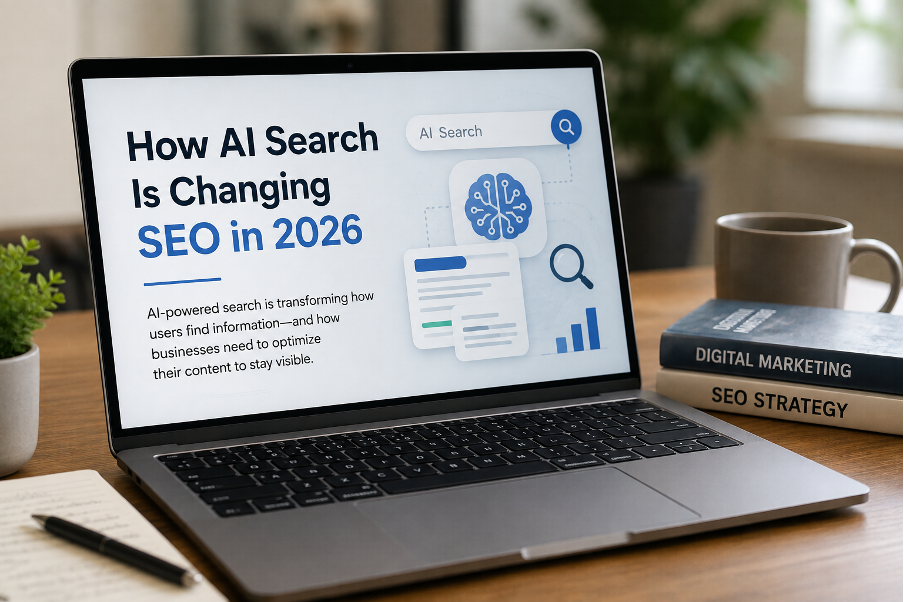
The biggest change is that search engines are moving from simply showing information to understanding and answering questions.
Traditionally, someone would search for a question, scan the results, click on a website, and find the answer there.
Now, AI-powered search can sometimes provide that answer directly within the search experience.
This creates a new challenge for businesses. Getting your page into the search results is still important, but simply ranking at the top doesn’t automatically guarantee the same number of clicks you might have received in the past.
In other words, SEO is no longer just about rankings. It’s about visibility, relevance, trust, and being included in the answer.
SEO Now Has Two Audiences: People and AI
One of the most important changes in modern SEO is that your content needs to work for two different audiences.
The first is obvious: human readers.
Your content needs to be interesting, easy to understand, useful, and persuasive enough to encourage someone to take the next step.
The second audience is increasingly important: AI systems and search agents.
AI systems can crawl websites, understand information, summarize content, and use facts from different sources when creating an answer for a user.
That means your content has to do two jobs at the same time:
- Give people a useful and enjoyable experience.
- Make important information clear enough for AI systems to understand and reference.
A page filled with vague marketing language may sound good to a person but provide very little useful information for an AI system trying to understand what the business actually offers.
Are AI Overviews Reducing Organic Website Traffic?
This is one of the biggest concerns for SEO professionals in 2026.
AI-generated summaries can answer certain informational searches directly within the search results. When users get what they need immediately, they may have less reason to click through to a website.
This is particularly relevant for searches such as:
- What is SEO?
- How does email marketing work?
- What is a mortgage?
- How do I choose a laptop?
- What are the benefits of a particular service?
If the search engine provides a satisfactory answer immediately, the user may never reach the websites that originally provided the information.
This doesn’t mean every website will experience the same impact.
Commercial and transactional searches can behave differently. When someone is ready to compare products, check prices, read detailed reviews, contact a company, or make a purchase, visiting a real website can still be an important part of the decision-making process.
The key takeaway is simple:
A number-one ranking doesn’t necessarily mean the same amount of traffic it used to.
Why AI Citations Are Becoming Important for SEO
If users don’t always click through to websites, businesses need to think beyond traditional rankings.
One increasingly important form of visibility is being cited or mentioned within AI-generated answers.
When an AI system references a business or website as a source, it can help establish credibility and brand awareness—even when the user doesn’t immediately click the link.
This is one reason the term Generative Engine Optimization (GEO) has become more common in SEO discussions.
GEO isn’t necessarily a replacement for traditional SEO.
Instead, think of it as an additional layer of optimization that focuses on helping AI systems:
- Understand your content.
- Identify important information.
- Recognize your expertise.
- Extract useful answers.
- Connect your brand with relevant topics.
- Reference your website when appropriate.
The goal isn’t simply to “write for AI.” The goal is to create high-quality content that is genuinely useful to people and easy for machines to understand.
What Makes Content More Likely to Be Cited by AI?
There isn’t a single formula that guarantees an AI citation. However, several content practices can make information easier for AI systems to understand and use.
1. Create Clear and Easy-to-Quote Content
Avoid hiding your main answer inside long paragraphs.
Use descriptive headings, short paragraphs, definitions, bullet points, and direct answers.
For example, instead of spending 300 words building up to an explanation of “What is technical SEO?”, answer the question clearly near the beginning and then expand on it.
This helps both readers and AI systems find the information they’re looking for.
2. Demonstrate Expertise and Authority
Trust matters more than ever.
Clearly communicate who created the content and why they are qualified to discuss the subject. Use reliable sources where appropriate and avoid making claims that cannot be supported.
A website that consistently publishes accurate, useful information can build stronger authority over time.
3. Use Schema Markup and Structured Data
Search engines and AI systems need to understand what information exists on a page.
Structured data can provide additional context about content such as:
- Products
- Reviews
- FAQs
- Organizations
- Articles
- How-to content
Schema markup doesn’t replace good content, but it can help machines interpret the information on your website more clearly.
4. Keep Information Accurate and Updated
AI systems can compare information from multiple sources.
If your website contains outdated statistics, old service information, incorrect pricing, or unsupported claims, it may become less useful as a source.
Regularly reviewing important pages is therefore becoming an increasingly important part of SEO.
Why Brand Mentions Outside Your Website Matter
SEO isn’t limited to your own website anymore.
Your brand can appear across many parts of the internet, including:
- Review websites
- Industry publications
- Business directories
- Forums
- Social media
- News websites
- Third-party articles
These mentions can contribute to the broader picture of your brand’s online presence.
Think about it this way: if a business only talks about how great it is on its own website, that tells one story.
If customers, publications, industry websites, and other independent sources are also talking about that business, there is a much broader set of signals available to search systems.
That’s why off-page SEO and brand reputation remain important in the age of AI search.
How Personalization Is Changing Search Results
Search is also becoming more personalized.
Two people can search for the same phrase and potentially receive different results depending on factors such as their previous interactions, preferences, context, and search behavior.
This makes the idea of one universal “best ranking position” more complicated.
For businesses, it means creating content that genuinely satisfies different search intents is becoming more important than trying to optimize a page around a single keyword alone.
Instead of asking:
“How do I rank for this keyword?”
SEO teams should increasingly ask:
“What does someone searching for this topic actually want to know or accomplish?”
That shift can lead to better content and a stronger user experience.
How AI Agents Are Changing the Future of Search
Another major development is the growth of AI agents.
Instead of a person manually searching for information, an AI agent can increasingly perform research, compare options, gather information, or assist with tasks on the user’s behalf.
For businesses, this creates another reason to make website information easy to understand and process.
Consider a page that says:
“We provide world-class solutions designed to transform your business.”
It sounds professional, but it doesn’t tell an AI agent much.
Now compare that with clear information about:
- What the company offers
- Who the service is for
- Pricing or pricing structure
- Product specifications
- Locations served
- Features
- Policies
- Contact information
The second version is much easier for both humans and machines to understand.
Clear information is becoming an SEO advantage.
What Should Businesses Do to Prepare for AI Search?
The good news is that you don’t need to completely abandon traditional SEO.
Instead, you should build on what already works.
Here are some practical steps businesses can take in 2026:
Continue Creating Helpful Content
Don’t create content simply because you found a keyword with search volume.
Focus on questions your customers actually ask and provide useful, accurate answers.
Make Your Content Easy to Understand
Use clear headings, short paragraphs, lists, definitions, examples, and direct answers.
Make important information easy to find instead of hiding it behind unnecessary text.
Strengthen Your Technical SEO
Make sure your website is technically healthy.
Pay attention to:
- Indexability
- Internal linking
- Site structure
- Page speed
- Mobile usability
- Canonical tags
- XML sitemaps
- Structured data
- Broken links
Technical SEO remains the foundation that allows search engines and AI systems to discover and understand your website.
Build Your Brand Beyond Your Website
Work on legitimate mentions, reviews, industry relationships, digital PR, and other activities that strengthen your overall online presence.
Your website shouldn’t be the only place where your brand exists.
Track More Than Rankings
Keyword rankings are still useful, but they shouldn’t be the only performance metric.
Businesses should also pay attention to:
- Organic traffic
- Search impressions
- Click-through rates
- Branded searches
- Conversions
- AI visibility and citations where measurable
- Engagement and user behavior
This gives you a more complete picture of how your website is performing in modern search.
Is AI Search the End of Traditional SEO?
No.
AI search isn’t making SEO irrelevant. It’s making SEO broader and more sophisticated.
Technical SEO, quality content, backlinks, user experience, keyword research, and website authority still matter.
What’s changing is how people discover information and how search systems decide which information to surface.
The businesses that succeed will be the ones that stop thinking only about “ranking number one” and start thinking about the complete search journey.
Your content needs to be good enough for a person to trust, clear enough for a machine to understand, and authoritative enough to be considered a useful source.
Final Thoughts: The Future of SEO Is About Being the Best Answer
SEO in 2026 is no longer just about getting a blue link at the top of Google.
It’s about becoming a reliable source of information wherever people—and increasingly AI systems—look for answers.
That means creating useful content, maintaining a technically strong website, demonstrating genuine expertise, building your brand across the web, and making important information easy to understand.
AI search may change how people discover websites, but the basic principle hasn’t changed:
The businesses that provide the most useful and trustworthy information have the strongest foundation for long-term visibility.
Instead of waiting for search to return to the way it was, businesses should adapt now.
The future of SEO isn’t about choosing between people and AI.
It’s about creating content that works for both.
Frequently Asked Questions About AI Search and SEO
1. Is traditional SEO dead because of AI search?
No. Traditional SEO is still important. Technical SEO, helpful content, website usability, authority, and relevant links continue to support online visibility. However, businesses now need to consider AI-generated search experiences in addition to traditional rankings.
2. What is Generative Engine Optimization (GEO)?
Generative Engine Optimization, or GEO, focuses on creating and structuring content so AI-powered search systems can understand, summarize, and potentially reference it accurately. GEO works alongside traditional SEO rather than completely replacing it.
3. Why is my website ranking well but getting less organic traffic?
One possible reason is that AI-generated answers are appearing for some of the searches you rank for. When users receive enough information directly in the search results, they may not always click through to individual websites.
4. How can I make my website content easier for AI to understand?
Use clear headings, concise answers, descriptive sections, structured data, accurate information, and trustworthy sources. Make sure important facts are easy to find and avoid relying only on vague promotional language.
5. Do backlinks still matter in the age of AI search?
Yes. Backlinks and off-site brand mentions can still contribute to a website’s authority and online reputation. A strong presence across reputable websites, publications, directories, and other relevant platforms can complement your on-site SEO efforts.
6. Should businesses optimize content specifically for AI?
Businesses should primarily focus on creating genuinely helpful content for their audience. At the same time, using clear structure, accurate information, descriptive headings, and structured data can make that content easier for both search engines and AI systems to understand.
7. What SEO metrics should businesses track in 2026?
Don’t rely only on keyword rankings. Track organic traffic, impressions, click-through rates, conversions, branded searches, engagement, and—where reliable measurement is available—visibility or citations in AI-generated search experiences.