If you want your website to rank higher on Google, attract qualified visitors, and convert more leads, On-Page SEO is where you should start.
No matter how many backlinks you build or how strong your brand authority becomes, poor on-page optimization can prevent your content from reaching its full potential.
In this guide, you’ll learn exactly what On-Page SEO is, why it matters in 2026, the key ranking factors you can control, and how to optimize every page for both users and search engines.
What Is On-Page SEO?
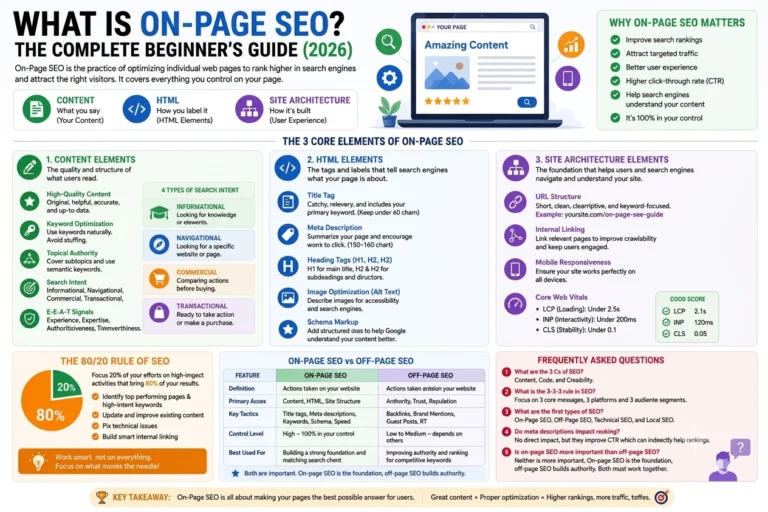
On-Page SEO is the process of optimizing individual webpages to improve their visibility in search engines and provide a better user experience.
It includes everything you directly control on your website, such as:
- Content quality
- Keyword optimization
- Page titles
- Meta descriptions
- Heading structure
- Internal links
- Images
- Page speed
- Mobile usability
Think of On-Page SEO as the foundation of your entire SEO strategy.
While Off-Page SEO builds authority through external signals, On-Page SEO helps search engines understand exactly what your page is about and whether it satisfies user intent.
Why On-Page SEO Matters
Imagine writing an amazing book but publishing it without a title, chapter headings, or cover.
Even if the content is excellent, nobody would know what it is about.
That’s exactly what happens when a webpage lacks proper On-Page SEO.
Effective on-page optimization helps:
 Improve search rankings
Increase organic traffic
Enhance user experience
Reduce bounce rates
Improve click-through rates (CTR)
Help search engines understand your content
Most importantly, it ensures your content matches what users are searching for.
Search Intent Comes First
Before optimizing any page, understand the intent behind the search.
Google’s primary goal is to deliver the most relevant result for every query.
The four main types of search intent are:
Informational Intent
Users want to learn something.
Example:
“What is On-Page SEO?”
Navigational Intent
Users are looking for a specific website or brand.
Example:
“Google Search Console Login”
Commercial Intent
Users are comparing options before making a decision.
Example:
“Best SEO tools for beginners”
Transactional Intent
Users are ready to take action.
Example:
“Buy SEO software”
Every SEO decision should align with the user’s intent.
The Three Core Elements of On-Page SEO
Successful On-Page SEO can be divided into three major categories:
| Content Elements | HTML Elements | Site Architecture Elements |
| What users read | What search engines interpret | How pages are structured |
| Content quality | Title tags | URL structure |
| Keywords | Meta descriptions | Internal linking |
| Topical authority | Heading tags | Mobile optimization |
| Search intent | Alt text | Core Web Vitals |
Content Elements
Content remains the most important On-Page SEO factor.
Google’s algorithms continue to prioritize helpful, trustworthy, and original content.
1. Create High-Quality Content
Your content should be:
- Accurate
- Helpful
- Well-structured
- Easy to read
- Up-to-date
In 2026, Google increasingly rewards Information Gain.
This means your content should contribute something unique instead of repeating what competitors already published.
Examples include:
- Original research
- Case studies
- Expert opinions
- Industry insights
- Real-world examples
2. Keyword Optimization
Keywords help search engines understand your topic.
However, keyword stuffing is no longer effective.
Best Practices
Include keywords naturally
Use keywords in headings
Add related semantic terms
Write for users first
 Avoid forcing keywords into every paragraph
Modern SEO focuses on context rather than repetition.
3. Topical Authority & Semantic SEO
Google no longer evaluates pages in isolation.
It evaluates whether your website demonstrates expertise across an entire topic.
Topical authority is built by:
- Covering related subtopics
- Creating content clusters
- Using semantic keywords
- Answering user questions comprehensively
The more complete your topic coverage, the stronger your authority becomes.
4. Demonstrate E-E-A-T
Google evaluates content using:
Experience
First-hand knowledge and practical insights.
Expertise
Depth and accuracy of information.
Authoritativeness
Industry recognition and credibility.
Trustworthiness
Transparency, accuracy, and reliability.
Strong E-E-A-T signals can significantly improve content performance.
HTML Elements
HTML elements help search engines understand your content.
Title Tags
The title tag is the blue headline users see in search results.
Best Practices
Include primary keywords
Keep under 60 characters
Make it compelling
Example:
What Is On-Page SEO? Complete Beginner’s Guide (2026)
Meta Descriptions
Meta descriptions summarize your page.
Although they don’t directly impact rankings, they improve click-through rates.
Best Practices
Keep between 150–160 characters
Include primary keywords
Encourage users to click
Heading Structure (H1, H2, H3)
Headings organize content and improve readability.
H1
Main page title (only one per page).
H2
Major sections.
H3
Subsections within H2 topics.
A logical heading hierarchy helps both users and search engines navigate content.
Image Optimization
Images improve engagement but need optimization.
Best Practices
Add descriptive alt text
Compress image size
Use WebP format
Include relevant file names
Alt text also improves accessibility for visually impaired users.
Schema Markup
Schema markup provides structured data that helps Google better understand your content.
Popular schema types include:
- FAQ Schema
- Article Schema
- How-To Schema
- Local Business Schema
Schema can increase eligibility for rich search results and featured snippets.
Site Architecture Elements
URL Structure
URLs should be:
Short
Descriptive
Easy to read
Example:
yourwebsite.com/on-page-seo-guide
Avoid:
yourwebsite.com/page?id=12345
Internal Linking
Internal links connect pages within your website.
Benefits include:
- Improved crawlability
- Better user navigation
- Increased page authority distribution
Strategic internal linking helps search engines discover content faster.
Mobile Responsiveness
More than half of all searches happen on mobile devices.
Your website should:
Adapt to all screen sizes
Load quickly
Be easy to navigate
Google uses mobile-first indexing, making mobile optimization essential.
Core Web Vitals
Core Web Vitals measure page experience.
Largest Contentful Paint (LCP)
Measures loading speed.
Target:
Under 2.5 seconds
Interaction to Next Paint (INP)
Measures responsiveness.
Target:
Under 200 milliseconds
Cumulative Layout Shift (CLS)
Measures visual stability.
Target:
Under 0.1
Better Core Web Vitals improve both user experience and SEO performance.
The 80/20 Rule of SEO
The 80/20 principle states that 20% of your SEO efforts often produce 80% of your results.
Focus on:
- High-performing pages
- High-intent keywords
- Content updates
- Internal linking
- Technical fixes
Prioritizing these areas usually delivers the biggest SEO gains.
On-Page SEO vs. Off-Page SEO
| Feature | On-Page SEO | Off-Page SEO |
| Location | On your website | Outside your website |
| Goal | Improve relevance | Build authority |
| Control | Fully controlled by you | Depends on external sources |
| Examples | Content, titles, schema, speed | Backlinks, brand mentions, PR |
| Purpose | Match search intent | Increase trust |
Both are essential for long-term SEO success.
Common On-Page SEO Mistakes to Avoid
Keyword stuffing
Thin content
Duplicate content
Missing meta descriptions
Slow-loading pages
Broken internal links
Poor mobile experience
Missing image alt text
Avoiding these mistakes can significantly improve rankings and user engagement.
Conclusion
On-Page SEO remains the foundation of successful search engine optimization in 2026.
By optimizing your content, HTML elements, site architecture, and user experience, you make it easier for search engines to understand your pages and easier for visitors to find the information they need.
Start with search intent, focus on delivering genuine value, and continuously improve user experience. Combined with strong Off-Page SEO and Technical SEO, effective On-Page SEO creates the foundation for sustainable organic growth.